RF Connectors Guide (SMA - N-Type - BNC - TNC) | How to Make the Right Choice?
RF Connectors Guide (SMA - N-Type - BNC - TNC) | How to Make the Right Choice?
The most expensive mistake in RF systems is wrong connector selection. Installing 75Ω instead of 50Ω or using BNC in a vibrating environment can throw away the entire antenna system.In this guide, we compare in detail the 4 most used RF connectors (SMA, N-Type, BNC, TNC).
What is an RF Connector?RF (Radio Frequency) connectors are special coaxial connection elements that transmit high-frequency signals (MHz-GHz) with minimum loss and maximum stability.
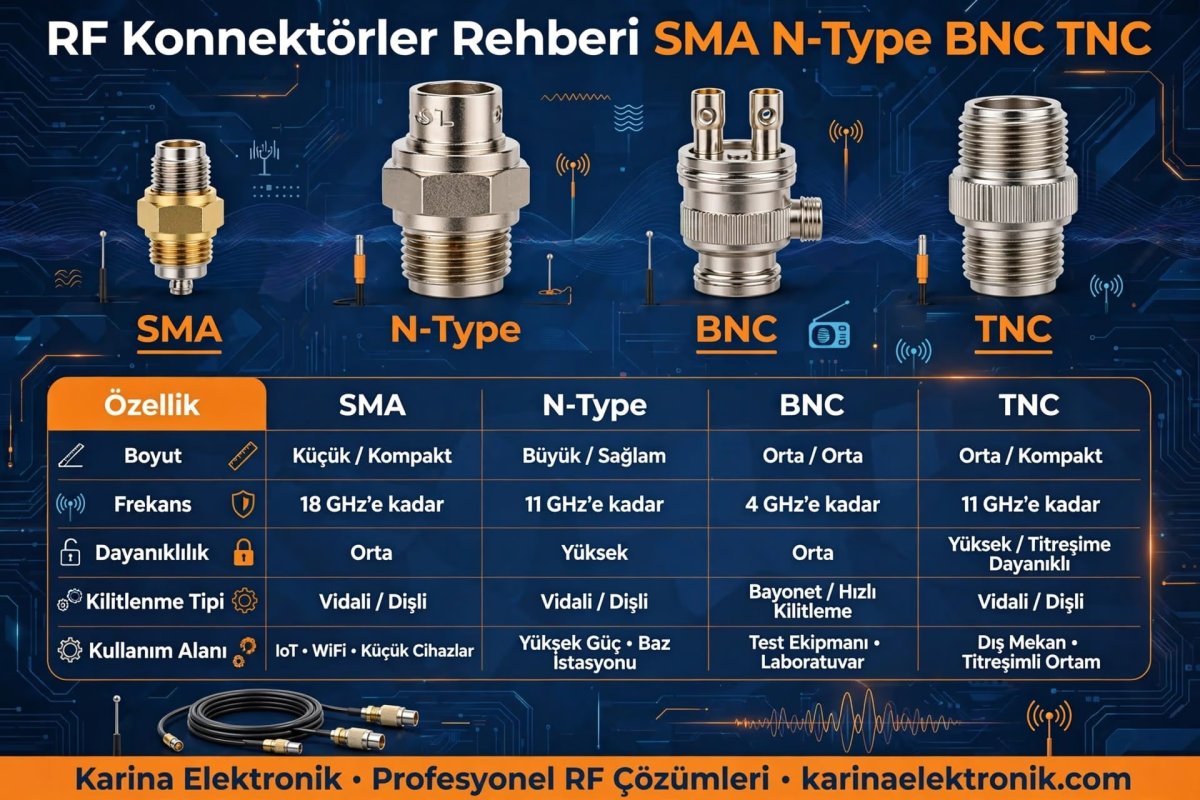
2 most critical concepts:Signal Integrity: Transmission without loss and reflectionImpedance Matching: The whole system must be at the same Ohm value (usually 50Ω)Where is it used? Telecom base stations, WiFi / 5G antennas, IoT devices, RF test equipment (oscilloscope, spectrum analyzer), military communication, satellite systems.1. SMA Connector - Small Giant, High FrequencyThe most popular in the RF world with its small size and high performance.Impedance: 50Ω (standard), rarely 75ΩFrequency: DC - 18 GHz (some versions up to 26.5 GHz)Connection: Screw - very stablePower: MediumUsage Areas: WiFi modules, IoT sensors, LoRa / Zigbee devices, PCB RF modules, drone FPV systems, RF test cablesAdvantage: Small size + high frequency + cheap + solderable to PCB
Disadvantage: Risk of thread stripping at high torque, insufficient at very high power2. N-Type Connector - Heavy Duty, High PowerBig, robust, resistant to outdoor environment. Indispensable for base stations.Impedance: 50Ω and 75Ω versions available (do not mix!)Frequency: DC - 11 GHzConnection: Screw, very robust, IP67 waterproof versions availablePower: Very high (up to kW level)Usage Areas: Base stations, outdoor antenna systems, heavy industrial RF, broadcast, radar systemsAdvantage: High power + low loss + outdoor + mechanically very robust
Disadvantage: Large and expensive3. BNC Connector - Fast Plug-Unplug, Laboratory KingConnection in 1 second with bayonet system. Standard of test devices.Impedance: 50Ω and 75Ω (75Ω very common for video)Frequency: DC - 4 GHzConnection: Bayonet - quarter turnPower: Low - mediumUsage Areas: Oscilloscopes, spectrum analyzers, signal generators, old type CCTV camera, laboratory test setupsAdvantage: Incredibly fast connection, saves time in testing, cheap
Disadvantage: Can open by itself in vibration, NOT suitable for outdoor, performance drops at high frequency4. TNC Connector - Armored Version of BNCTake BNC, make it screw type, make it vibration resistant = TNC.Impedance: 50Ω (standard)Frequency: DC - 11 GHz (much better than BNC)Connection: ScrewPower: MediumUsage Areas: Outdoor RF systems, vehicle-mounted radio, military communication, vibrating industrial machines, aviationAdvantage: BNC speed + SMA stability, vibration resistant, waterproof versions available
Disadvantage: Not as fast as BNC, not as small as SMAQuick Comparison TableSMA: Up to 18 GHz / Screw / Medium / IoT, WiFi, PCBN-Type: Up to 11 GHz / Screw / Very High / Base station, OutdoorBNC: Up to 4 GHz / Bayonet / Low-Medium / Lab, Test, OscilloscopeTNC: Up to 11 GHz / Screw / Medium / Vehicle, Military, VibratingWhich Connector When to Choose?Choose SMA if:
You are making small device (IoT, module, PCB)
Frequency is above 6GHz (WiFi 6, 5G, 18GHz test)
You will solder directly onto PCBChoose N-TYPE if:
You will transfer high power (above 10W)
You are installing outdoor antenna (base station, roof antenna)
It is industrial and long-lasting systemChoose BNC if:
You are doing laboratory test and measurement
You need continuous plug-unplug
It is video / oscilloscope connection (75Ω BNC)Choose TNC if:
There is vibrating environment (vehicle, machine, boat)
Outdoor but you do not want it to come out as fast as BNC
You complain about BNC not being stable4 Most Common Fatal MistakesMixing 50Ω / 75Ω: If you install 50Ω BNC on 75Ω system, VSWR deteriorates, 20% of signal reflects back.Using BNC at High Frequency: Installing BNC on 6GHz WiFi system = half of signal is lost. Above 4GHz SMA or N-Type is mandatory.Choosing Non-Sealed for Outdoor: Standard SMA takes water inside. For outdoor you must buy IP67 sealed SMA / N-Type.BNC in Vibrating System: If you install BNC on vehicle radio, bayonet opens after 1 week, communication cuts off. TNC is mandatory.Conclusion: Right Choice = Long Life
RF connector selection is an engineering decision that directly affects system performance. Right choice = low loss + high stability + long-lasting system + low maintenance cost.
For SMA, N-Type, BNC, TNC and all RF connectors: https://www.karinaelektronik.com/